How to Build a Data Science Portfolio That Gets You Hired in 2026
What hiring managers actually look for in a data science portfolio — moving beyond Kaggle notebooks to production systems, real metrics, domain expertise, and the projects that demonstrate ML engineering depth.
Most data science portfolios look the same: Titanic survival prediction, iris classification, a sentiment analysis notebook. These don't get you hired at companies that build real ML systems.
After reviewing dozens of portfolios and building my own across ML engineering, data science, backend, and frontend work, here's what actually differentiates candidates.
The Problem With Most DS Portfolios
The average portfolio demonstrates: "I know how to run sklearn on a Kaggle dataset." That's table stakes. What hiring managers want to know:
- Can you take a problem from ambiguous business question to deployed solution?
- Do you know what happens to a model after
model.fit()? - Can you measure whether your model is actually working in production?
- Do you understand the engineering constraints your model must operate within?
The 5 Project Types That Signal ML Engineering Depth
1. A Production ML System (Not a Notebook)
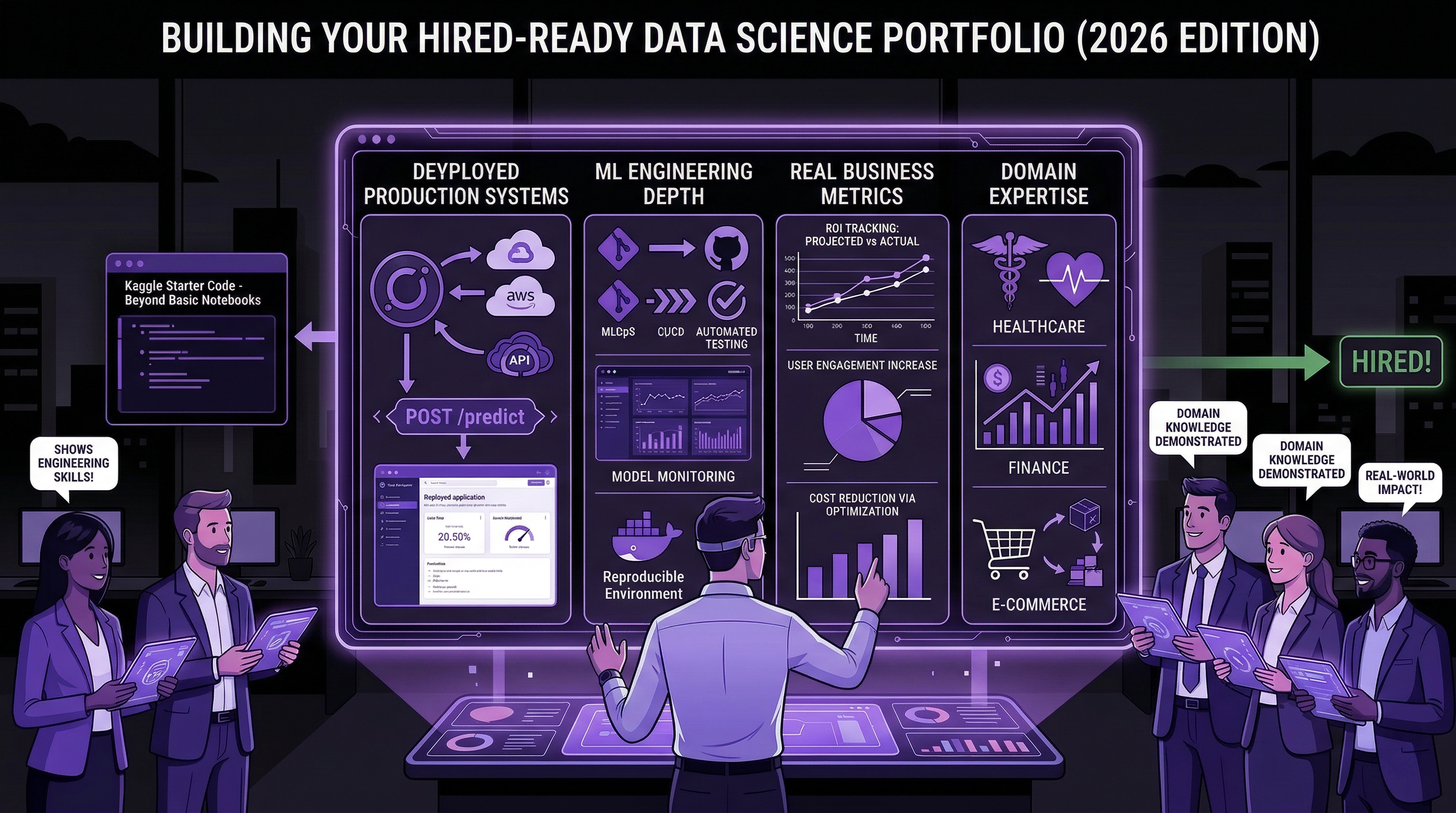
Take any ML project and add: a FastAPI serving layer, Docker containerization, input validation, a health check endpoint, and basic logging. This immediately separates you from notebook-only portfolios. The model doesn't need to be impressive — the engineering does.
2. An Evaluation Framework
Building a system that measures model quality — hallucination rate, semantic accuracy, bias detection — demonstrates that you understand the gap between "model works in notebook" and "model works in production." This is rare and highly valued.
3. A Data Pipeline (End-to-End)
Ingest raw data → validate schema → engineer features → train model → serve predictions. The pipeline doesn't need to be complex, but it needs to be automated, reproducible, and handle edge cases (missing values, schema drift, late-arriving data).
4. Something in Your Passion Domain
Generic projects are forgettable. A project that combines ML with something you genuinely care about — Formula 1 strategy, music generation, language learning, sports analytics — is memorable and credible. The domain knowledge shines through in feature engineering and problem framing.
5. A Developer Tool or Open-Source Contribution
Building something other engineers use (a CLI tool, an API, an evaluation library) demonstrates software engineering maturity beyond data science. It also creates backlinks, GitHub stars, and real users — social proof that your work has value.
What Every Portfolio Project Should Have
- A clear problem statement — what business/technical problem does this solve?
- Production metrics — not just accuracy, but latency, throughput, error rates
- Technical decisions with rationale — why XGBoost over a neural network? Why Redis?
- A live demo or deployed URL — a running system is worth 10× a notebook
- Code quality — type hints, docstrings, tests, CI/CD at least at a basic level
SEO and Visibility: Your Portfolio as a Signal
Your portfolio site should be findable. Write blog posts that target keywords hiring managers and technical recruiters search for. A blog post titled "Building a Production LLM Evaluation Pipeline" will rank for "LLM evaluation Python" — and the engineer reading it is exactly the person who would want to hire you.
The Stack That Shows Breadth
The combination that consistently gets strong responses from both ML teams and engineering teams:
- Python for ML and data engineering (expected)
- FastAPI for serving (shows deployment awareness)
- Docker for containerization (shows infra awareness)
- SQL demonstrated on a real dataset (non-negotiable for DS roles)
- One frontend project (even basic) — shows you can communicate your work visually
Final Advice: Quality Over Quantity
Three excellent projects with live URLs, real metrics, and clear engineering decisions outperform fifteen notebook-level projects every time. Depth beats breadth at the portfolio stage. The interview is where you go broad.