Neuro-Symbolic AI: How to Build Reliable LLM Pipelines That Don't Hallucinate
Pure LLM generation fails ~60% of the time for structured outputs. Learn how neuro-symbolic architecture combines AI reasoning with deterministic templates to achieve 99%+ production reliability.

Large language models are extraordinary reasoning engines — but they are unreliable code generators. When we first built the Text-to-Animation Engine at Edza.ai, we asked GPT-4 to write Manim animation scripts directly. The failure rate was 62%. Models called non-existent functions, placed text labels over diagrams, and generated LaTeX that wouldn't compile.
The solution wasn't a better prompt. It was a fundamentally different architecture: neuro-symbolic AI.
What Is Neuro-Symbolic AI?
Neuro-symbolic AI combines neural networks (for reasoning, language understanding, content synthesis) with symbolic systems (deterministic rules, templates, formal structures). The neural component handles the parts that require intelligence. The symbolic component handles the parts that require correctness.
Applied to LLM pipelines, this means: use the model for what it's good at, and constrain it from doing what it's bad at.
The Core Problem: LLMs Lack Spatial and Structural Awareness
When you ask an LLM to generate structured output — code, animation scripts, SQL, JSON schemas — it uses the same mechanism it uses to generate prose: next-token prediction. There is no internal model of "does this function exist?" or "will this code compile?". The model confidently generates plausible-looking but broken output.
This is especially severe for domain-specific libraries (Manim, Pandas, SQL dialects) where the training data is sparse and function signatures vary across versions.
The Neuro-Symbolic Solution: Confidence-Gated Routing
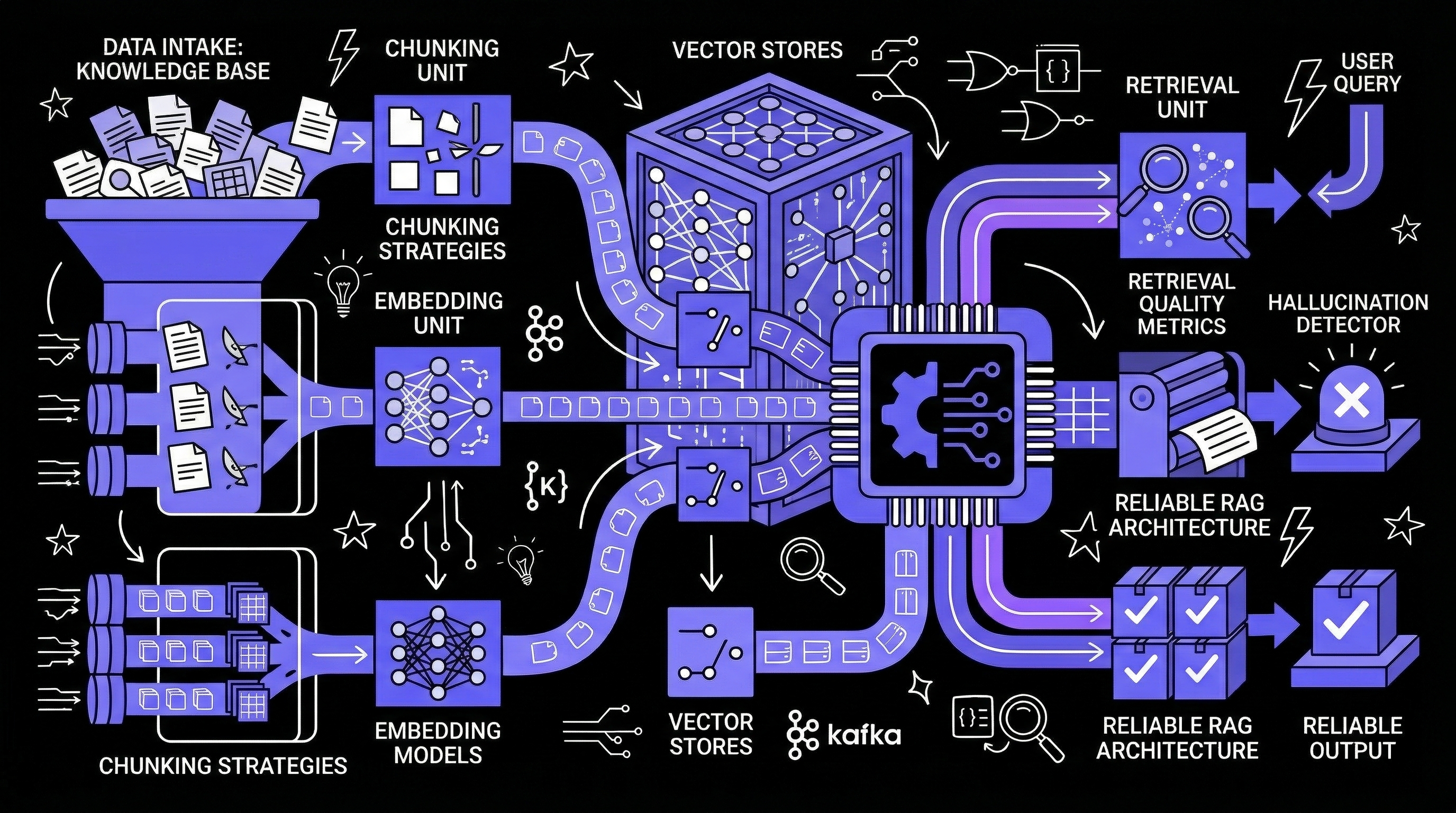
Our architecture introduced a three-stage pipeline:
- Subject Classification — a lightweight classifier determines topic domain and returns a confidence score
- Confidence-Gated Routing — if confidence ≥ 85%, route to domain-specific template engine; else trigger Wikipedia-grounded fallback
- Template-Constrained Generation — the LLM fills structured slots within a deterministic scaffold, not freeform generation
def route_topic(topic: str, subject: str, confidence: float):
    CONFIDENCE_THRESHOLD = 0.85
    if confidence >= CONFIDENCE_THRESHOLD:
        return domain_template_engine(subject, topic)
    else:
        return wikipedia_fallback_pipeline(topic, subject)
Template Architecture: Constraining the Generation Space
Instead of asking the model to invent both logic and structure, we provide strict scaffolds. Each template enforces: scene sequencing rules, allowed API constructs, naming conventions, object initialization standards, and explicit animation boundaries.
For mathematics topics, the scaffold enforces: introduction → definition → derivation → visualization → summary. The model fills content within those phases. It cannot deviate from the structure.
MATH_TEMPLATE = """
You are generating a Manim scene for: {topic}

SCENE STRUCTURE (do not deviate):
1. Title card using Text("{topic}").scale(1.2)
2. Definition block — use MathTex for all equations
3. Step-by-step derivation — use TransformMatchingTex for transitions
4. Visual diagram — use axes from Axes() only
5. Summary card

CONSTRAINTS:
- Never use deprecated VMobject methods
- All LaTeX must be valid — test each equation mentally
- Maximum 3 animations per step
"""
Results: From 38% to 99.4% Success Rate
After implementing the neuro-symbolic architecture across Physics, Chemistry, Mathematics, and Computer Science subjects:
- Animation success rate: 38% → 99.4%
- P95 end-to-end latency: 85 seconds
- Audio synchronization: <100ms
- Fallback coverage: 100% of topics produce usable output
When to Use Neuro-Symbolic vs Pure Generation
Use neuro-symbolic when: output must be executable/valid (code, SQL, config files), the domain has strict structural rules, or failure has real production cost.
Pure generation works well for: open-ended prose, creative writing, summarization, and tasks where "approximately correct" is sufficient.
Key Takeaways
- LLMs are reasoning engines, not compilers — don't treat them as both
- Confidence-gated routing prevents template mismatch failures before they happen
- Deterministic scaffolds convert unreliable generation into a controlled production pipeline
- Separating failure boundaries enables independent testing of each component